Google Gemini 4 Hydrogen robotics plugin for Antigravity; Google says 58 on AA-Robotics
Updates
- Updated Nov. 17: Artificial Analysis now lists Gemini 4 Hydrogen at 58 on AA-Robotics v0.1, behind new leader GPT-6.2 Astra (79), GPT-6.2 Sol (78) and Claude Fable 5.2 (75). An earlier version of this story said AA's public table did not list Hydrogen and that a 58 would rank third; it ranks no higher than sixth.
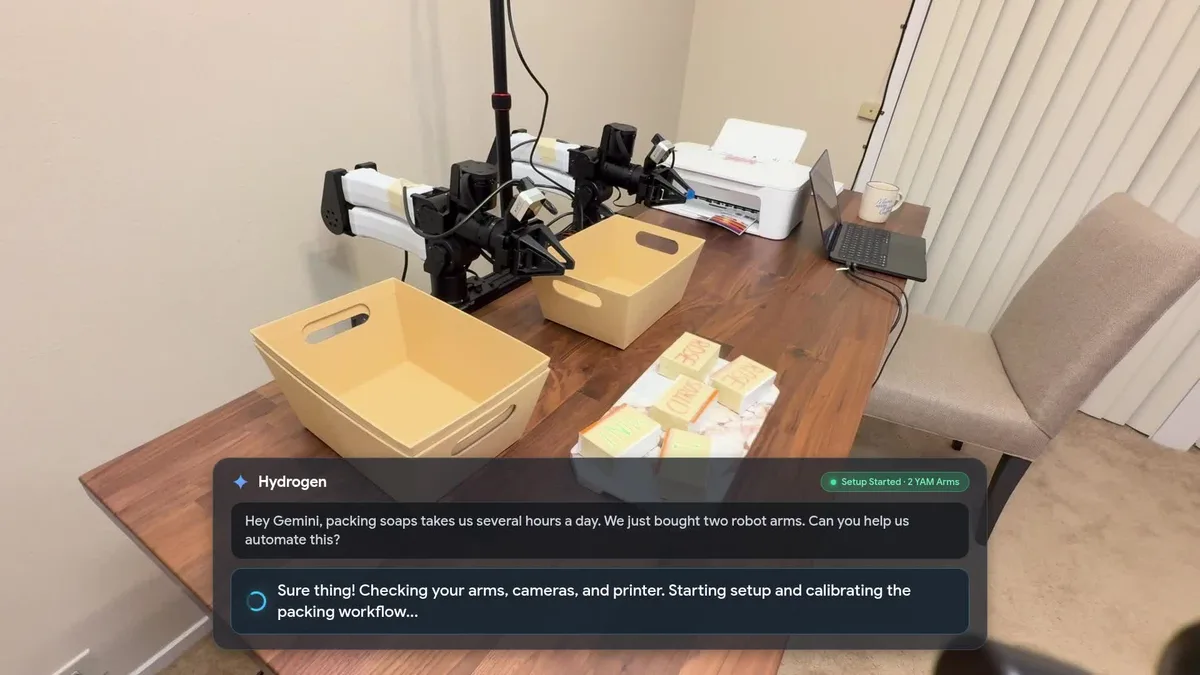
Google on Nov. 17 launched a Robotics plugin for Google Antigravity, its AI coding environment, built around Gemini 4 Hydrogen, the faster Gemini 4 model it released on Nov. 12. The plugin adds skills for robot bring-up from a USB cable, MuJoCo simulation, perception and closed-loop control, and application building. Google says an I2RT YAM arm was calibrated and ready for tasks in about 10 minutes, with similar flows for the low-cost SO-ARM101 and an FR3 Duo. Google also says Hydrogen scores 58 on Artificial Analysis's AA-Robotics v0.1, where a model drives a real 6-axis arm through eight tabletop tasks, and calls that similar to Gemini 4 Argon at a lower cost per token. Artificial Analysis's own Nov. 17 update lists Hydrogen at 58, behind OpenAI's new GPT-6.2 Astra at 79. Antigravity requires a paid Google AI Pro or Ultra plan; Hydrogen is also in the Gemini API.
Servospace take: Hydrogen's 58 trails OpenAI's new 79 on AA-Robotics, so Google is selling price and setup speed, not the top score
Servospace analysis: Artificial Analysis said on Nov. 17 that GPT-6.2 Astra now leads AA-Robotics v0.1 at 79, ahead of GPT-6.2 Sol (78), Claude Fable 5.2 (75) and Gemini 4 Hydrogen (58), which matches Google's figure. On AA's Oct. 14 table, GPT-6 Astra (69.4) and GPT-6.1 Sol (64.6) also scored above 58, so Hydrogen ranks no higher than sixth among the AA-Robotics scores published so far, 21 points behind the leader (Servospace arithmetic). It does edge Google's own Gemini 4 Argon (55.3) by 2.7 points and beats Claude Opus 5.5 (48.8) and Claude Fable 5.1 (46.3). Price is the pitch. Artificial Analysis lists Hydrogen at $1.50 per million input tokens and $7.50 per million output tokens, and its Oct. 14 write-up found the five models it tested then about 100 times slower than a human, about 30 minutes per task against 20 seconds, calling them far too slow and expensive for production use. Google is also folding its separate robotics line into the main model: it recommends developers using Gemini Robotics ER 2 try Hydrogen, and its chart shows Hydrogen averaging 84.8 against ER 2's 75.5 across 15 embodied-reasoning tests, though ER 2 still leads on steerable pointing. Watch for AA's harder tasks, which it says it is adding, and for which arm makers ship with the plugin.
More on OpenAI, Google DeepMind and robot ai.
Sources
- Google Developers Blog (Nov. 17, 2026): Gemini 4 Hydrogen, a faster model for general purpose robotics (Robotics plugin for Antigravity, AA-Robotics score of 58, YAM bring-up in about 10 minutes, Hydrogen vs. Gemini Robotics ER 2 chart)
- Google (Nov. 12, 2026): Introducing Gemini 4 Hydrogen
- Artificial Analysis (Oct. 14, 2026): Introducing AA-Robotics v0.1 (GPT-6 Astra 69.4, GPT-6.1 Sol 64.6, Gemini 4 Argon 55.3, Claude Opus 5.5 48.8, Claude Fable 5.1 46.3; models about 100 times slower than humans)
- Artificial Analysis (Nov. 17, 2026): GPT-6.2 Astra and GPT-6.2 Sol release (GPT-6.2 leads AA-Robotics v0.1: Astra 79, Sol 78, Claude Fable 5.2 75)
- Artificial Analysis on X (Nov. 17, 2026): GPT-6.2 Astra leads AA-Robotics v0.1 at 79, ahead of GPT-6.2 Sol (78), Claude Fable 5.2 (75) and Gemini 4 Hydrogen (58)
- Artificial Analysis: Gemini 4 Hydrogen model page (released Nov. 12, 2026; $1.50 input and $7.50 output per million tokens)
New to robots? Read our guide: How robots work: a beginner's guide.
Summarized by Servospace from the sources above, drafted with AI help and checked against those sources before publishing. Claims are the companies' or outlets' unless we say otherwise. How we work.