OpenAI disbands its stand-alone robotics team: researchers move under Mark Chen, hardware under Greg Brockman, in a bet that general models like GPT-6 Astra can run robots
OpenAI has disbanded its stand-alone robotics team, Fortune reported on Nov. 13, 2026, and the company confirmed the change to Fortune. Robotics researchers move to the main research team under Chief Research Officer Mark Chen. Applied robotics and hardware teams move to the Applied organization under President Greg Brockman.
OpenAI says it is not leaving robotics. A spokesperson told Fortune its general frontier models, including GPT-6 Astra, have shown they can be applied directly to robots. CEO Sam Altman's target of a first public humanoid demo in 2027 stands, per Fortune and TokenPost.
It is OpenAI's second reset. It wound down a robotics team in 2020 and rebuilt one in 2024 alongside a Figure partnership that ended in February 2025. Fortune found OpenAI's registered CoRL booth, No. 208, empty this week. OpenAI's job board still listed 15 Robotics openings on Nov. 13.
Servospace take: the robot brain is becoming a feature of the frontier model, but the benchmark bill is steep
Servospace analysis: OpenAI is not leaving robots. It is betting the robot brain becomes one more use of its main model, the way coding and legal tools run on the same models. If that holds, startups selling a separate robot foundation model face a bigger rival on intelligence, and humanoid makers may get another general-purpose brain to buy or license instead of build, if OpenAI sells robotics access. OpenAI has not announced a robotics license.
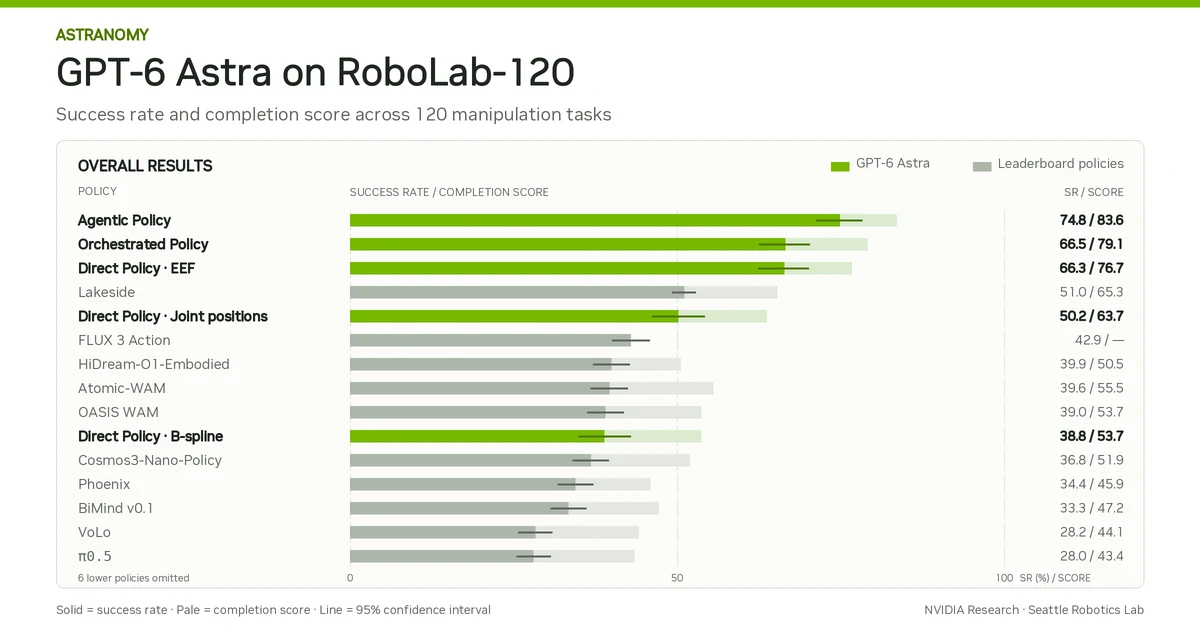
The cost case is not settled. In NVIDIA's Oct. 14 Astranomy study, the one Fortune cites, GPT-6 Astra in its best agent setup succeeded on 74.8% of 120 simulated general-purpose pick-and-place and manipulation tasks, against 51.0% for the top specialized policy. NVIDIA put that setup at $36.40 in tokens per episode, or about $48.66 per success by our math. Its direct mode cost $1.96 per episode, with model calls averaging 18.56 seconds. All of it was in simulation, paused while the model thought.
That leaves room for the companies with robots already at work. MIT professor Russ Tedrake, CEO of Walden Robotics, told Fortune that deployment data gets more valuable as base models improve. CMU's Guanya Shi told Fortune small onboard models are still needed when a robot cannot wait on the cloud.
The hardware work continues. OpenAI's public job board listed 15 openings under Robotics on Nov. 13, all in San Francisco and mostly hardware roles in actuators, motors, circuit boards and firmware. The newest was posted Nov. 12. Engadget counted 27 robotics openings on Oct. 17. Job boards move, and the gap is not evidence of a headcount cut.
More on Figure AI, OpenAI, Nvidia and robot ai.
Sources
- Fortune (exclusive): OpenAI disbands its stand-alone robotics team as its general models start running robots, by Wen Shao (Nov. 13, 2026)
- TokenPost: OpenAI moves robotics work into research and Applied teams (Nov. 13, 2026)
- Techmeme roundup of the Fortune report (Nov. 13, 2026)
- NVIDIA Research, Seattle Robotics Lab: Astranomy, an empirical study of GPT-6 Astra as a native robot policy (Oct. 14, 2026)
- OpenAI job board: Robotics openings (checked Nov. 13, 2026)
- Engadget: OpenAI is building a humanoid robot (Oct. 17, 2026), Altman's 2027 demo quote and robotics openings
- TechCrunch: Figure drops OpenAI in favor of in-house models (Feb. 4, 2025)
New to robots? Read our guide: How robots work: a beginner's guide.
Summarized by Servospace from the sources above, drafted with AI help and checked against those sources before publishing. Claims are the companies' or outlets' unless we say otherwise. How we work.