Gemini Robotics 2.5: Apptronik Apollo 2 humanoids hit 96% in a Mercedes-Benz kitting pilot at Kecskemet and Sindelfingen, Nov. 10, 2026
Google DeepMind released Gemini Robotics 2.5, its newest vision-language-action (VLA) model, on Nov. 10 and said it is rolling out to its robotics partners. Ars Technica reports it is not generally available, and that the partners include Agile Robots, Apptronik and Boston Dynamics.
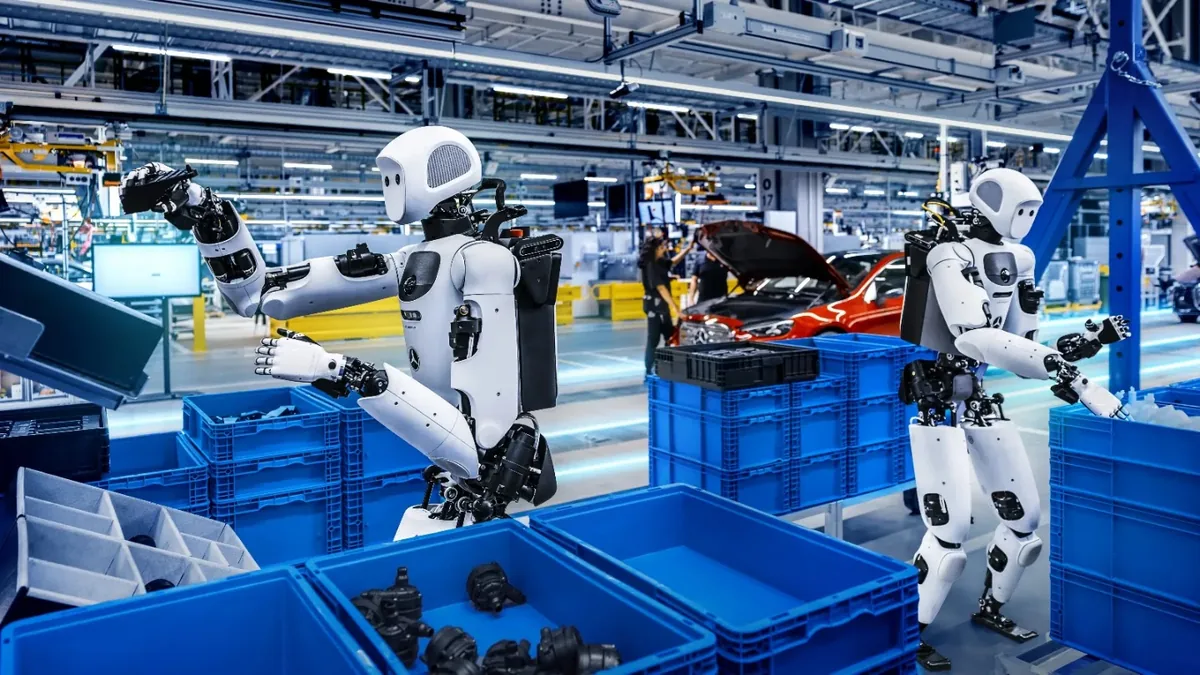
The headline number comes from a proof of concept, not a commercial deployment. DeepMind, Apptronik and Mercedes-Benz ran Apptronik's Apollo 2 humanoids on active production lines in Kecskemét, Hungary, and Sindelfingen, Germany. The robots did automotive kitting: picking metal brackets from bulk bins and placing them into sequencing containers in the order each vehicle needs. Gemini Robotics ER tracked the workflow while Gemini Robotics 2.5 controlled the hands and arms. DeepMind reports a 96% success rate. All pilot figures come from DeepMind; the announcement carries no Mercedes-Benz quote or figures.
In lab tests across 200 tasks, DeepMind claims a 30% to 100% higher success rate than its previous baselines, depending on the task, and 20% to 30% faster completion. Those are company claims. DeepMind also released ASIMOV-Jailbreak, an open benchmark of prompts that disguise unsafe requests for robots.
Servospace take: what 96% means on a kitting line
Servospace analysis: DeepMind calls the pilot promising progress, and for a general-purpose model on a live line it is. But a kitting cell is judged on misses. At 96%, about 4 of every 100 attempts fail, or roughly 40 per 1,000, about one every 25. DeepMind does not say whether it counted individual picks, filled trays or trial runs, so read that as an order of magnitude, not a rework rate. Ars Technica notes that a person doing the same repetitive task gets it right virtually every time, and DeepMind director Kanishka Rao said closing the last 4% gap will be a "steep road." DeepMind robotics head Carolina Parada framed the trade-off: specialize and lose generality, or push generalization "and maybe not get to 99.9 in every application." At 99.9%, misses fall to about 1 per 1,000, a 40-fold difference.
That gap decides who pays for the misses. In sequenced kitting, every empty or wrong slot has to be caught and fixed by a person before the tray reaches the line. DeepMind says the robot corrects for gaps, but it has not published a pick rate, cycle time, shift length or cost, so throughput against a human kitter cannot be judged from the release. Ars adds two caveats: the factory video is sped up 2x, and Gemini Robotics 2.5 still runs on cloud servers rather than on the robot, which adds latency and a network dependency on a production line.
The other signal is setup time. Apptronik CEO Jeff Cardenas says the models improved "dramatically in just a few weeks of post-training" and carried over to Mercedes-Benz production "with very little drop-off." That is a company claim, and it is the number buyers should test: how many weeks per new part family. NVIDIA's GR00T 2, covered by Servospace on Nov. 9, claimed a 95% average on its own 50-task evaluation with five demos each; DeepMind's 96% comes from a factory pilot, a different kind of test.
More on Boston Dynamics, Franka and humanoid robots.
Sources
- Google DeepMind (Carolina Parada): Gemini Robotics 2.5 accelerates real-world general dexterity (Nov. 10, 2026)
- Ars Technica (Ryan Whitwam): DeepMind reveals Gemini Robotics 2.5 and open safety benchmark ASIMOV-jailbreak (Nov. 10, 2026)
- The Decoder (Maximilian Schreiner): Google DeepMind's Gemini Robotics 2.5 scores 96 percent sorting metal parts in a Mercedes-Benz assembly pilot (Nov. 10, 2026)
Go deeper: Humanoid robots at work beyond Agility: what customers confirm.
Summarized by Servospace from the sources above, drafted with AI help and checked against those sources before publishing. Claims are the companies' or outlets' unless we say otherwise. How we work.