Tesla invites select buyers to order Cybercab at $29,990, with a $299-a-month Autonomy Subscription required to operate the car that has no steering wheel
Updates
- Updated Nov. 14: added terms of Tesla's Cybercab Autonomy Subscription Agreement (personal, non-commercial use only, geofenced operation, price changes on one month's notice), as reported by Electrek.
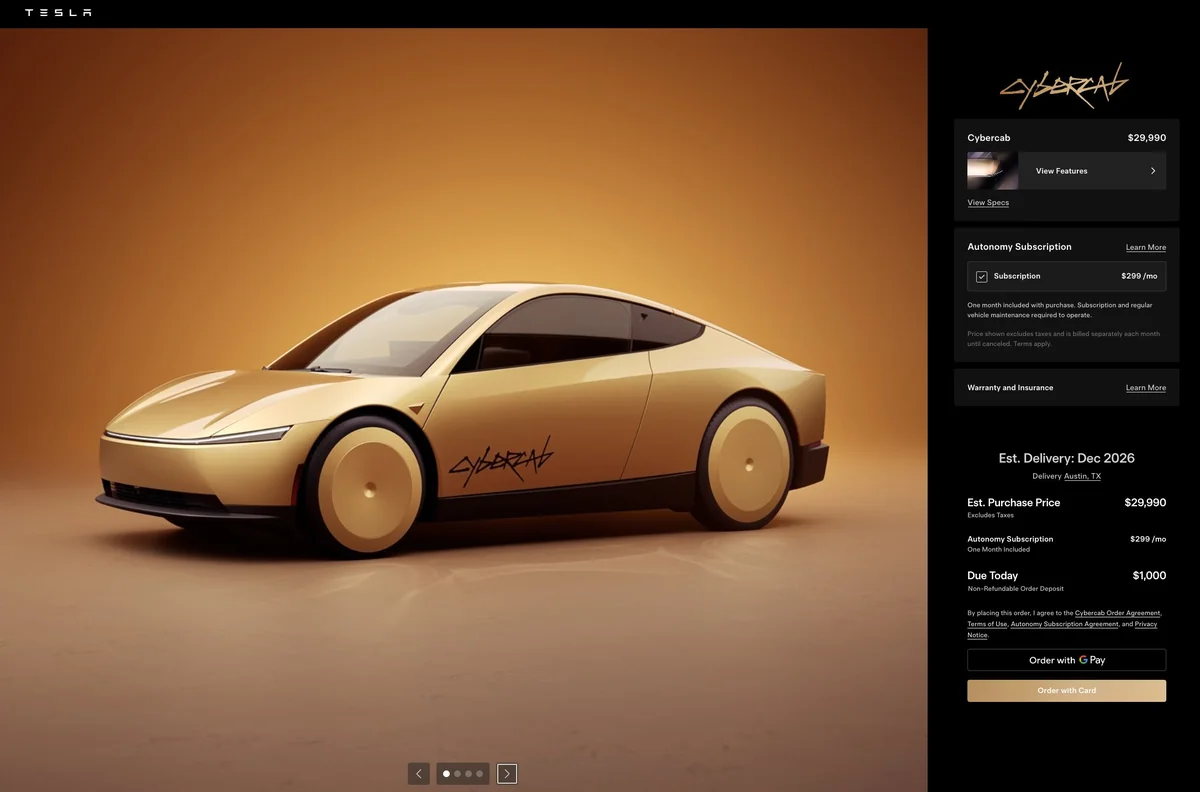
Tesla's Robotaxi account on X invited select customers at 6:27 p.m. ET on Nov. 13 to buy a Cybercab for personal use. The order screen lists $29,990 excluding taxes, a $1,000 non-refundable deposit, a required $299-a-month Autonomy Subscription with one month included, and estimated December delivery in Austin. Tesla's Cybercab page shows no steering wheel or pedals.
Tesla's Cybercab Autonomy Subscription Agreement (version 20261112), as reported by Electrek and TeslaNorth, says the car "will not operate without an active Autonomy Subscription." It limits use to personal, non-commercial trips inside Tesla-enabled Robotaxi geofences that Tesla can change, bars ride-hailing, delivery or rental use unless Tesla authorizes it in writing or enables it in the product, and allows price changes on one month's notice.
On Nov. 14, CEO Elon Musk replied on X that "the monthly fee is too high" and should be "more like ~$115/month." Tesla has not changed the price.
Servospace take: Tesla keeps the robotaxi revenue, and Cybercab buyers get a subscription, not a fleet asset
Servospace analysis: The agreement answers who makes money from a privately bought Cybercab: Tesla. The owner pays $29,990 up front plus a monthly fee, and may not put the car on Tesla's Robotaxi Network or any ride-hailing, delivery or rental platform unless Tesla authorizes it in writing or enables it in the product, so the owner cannot decide on their own to make the car earn back its cost. That fits what Musk said on the Oct. 21, 2026, earnings call, that the Cybercab will mainly be Tesla-owned and used for its ride-hailing service, Reuters reported. At $299 a month, 59 billed months over five years after the included first month total $17,641, or $47,631 with the sticker before taxes, by our math. At Musk's ~$115 figure, the same 59 months would total $6,785, a $10,856 difference, by our math. Tesla can change the price with one month's notice either way, so neither figure is a fixed cost.
The regulatory question is still open. The National Highway Traffic Safety Administration (NHTSA) opened Audit Query AQ26002 on Sept. 3, 2026, to examine how Tesla certified Cybercab vehicles that lack permanently attached conventional manual controls. NHTSA's open resume lists the population as 1,000 estimated, and The Verge reported the same figure. Unlike Amazon's Zoox, which received a temporary federal exemption on July 31, 2026, capping deployment at 2,500 vehicles per 12-month period, Tesla did not seek that exemption; asked on X whether the 2,500-vehicle cap applied, Tesla engineering chief Lars Moravy answered "No," EVXL reported, and Reuters independently reported the same remark. Tesla filed a one-page letter on Oct. 30, 2026, claiming confidentiality over its file, and EVXL reported on Nov. 8 that the NHTSA docket showed no ruling yet on that filing.
Still unknown: how many invites went out, whether Tesla will ever enable paid use for owners, whether and when Tesla actually cuts the fee, how far the geofence will reach (Musk wrote that the car "will be available nationwide, as we receive regulatory approval"), and whether NHTSA's audit will constrain deliveries.
More on Tesla, Zoox and robotaxis and self-driving vehicles.
The source post
Post by Tesla (@robotaxi) on X.
View the post on X
Sources
- Tesla Robotaxi (@robotaxi) on X: select customers invited to purchase Cybercab for personal use, with order screen (Nov. 13, 2026)
- Tesla Cybercab and Robotaxi page: no steering wheel, pedals or mirrors, two-passenger design
- Elon Musk (@elonmusk) on X: reply to @MKBHD saying the Cybercab monthly fee is too high and should be about $115 a month (Nov. 14, 2026)
- Electrek: Tesla Cybercab's autonomy agreement terms, by Fred Lambert (Nov. 14, 2026)
- TeslaNorth: Tesla Cybercab terms require a paid monthly subscription (Nov. 13, 2026)
- InsideEVs: Tesla Opens Cybercab Orders To 'Select Customers' At $29,990 Plus A $299 Per Month, by Tim Levin (Nov. 13, 2026)
- Drive Tesla: Tesla invites select customers to buy Cybercab for $29,990, by Darryn John (Nov. 13, 2026)
- Teslarati: Tesla Cybercab goes on sale for $29,990, slated for December deliveries, by Joey Klender (Nov. 13, 2026)
- Reuters brief (via NewsX syndication): Tesla Robotaxi invites select customers to purchase Cybercab for personal use (Nov. 13, 2026)
- Reuters (via StreetInsider): Tesla aims to sell Cybercab robotaxis by end of year despite federal probe, by Abhirup Roy (Oct. 21, 2026)
- NHTSA Office of Defects Investigation: Audit Query AQ26002 resume, Tesla Cybercab FMVSS Certification (opened Sept. 3, 2026)
- The Verge: Tesla Cybercab is barely on the road and it's already under investigation (Sept. 4, 2026)
- EVXL: Tesla clears Cybertruck line for a Cybercab still under NHTSA audit (Nov. 8, 2026)
- Reuters (via The Hindu): Elon Musk pushes regulatory limits with Tesla's Cybercab robotaxi service (Sept. 5, 2026)
Go deeper: How robotaxis work: Tesla vs Waymo, explained.
Summarized by Servospace from the sources above, drafted with AI help and checked against those sources before publishing. Claims are the companies' or outlets' unless we say otherwise. How we work.