Serve Robotics AV Delivery Developer Portal: public API and sandbox for developers and AI agents; live robots need approval
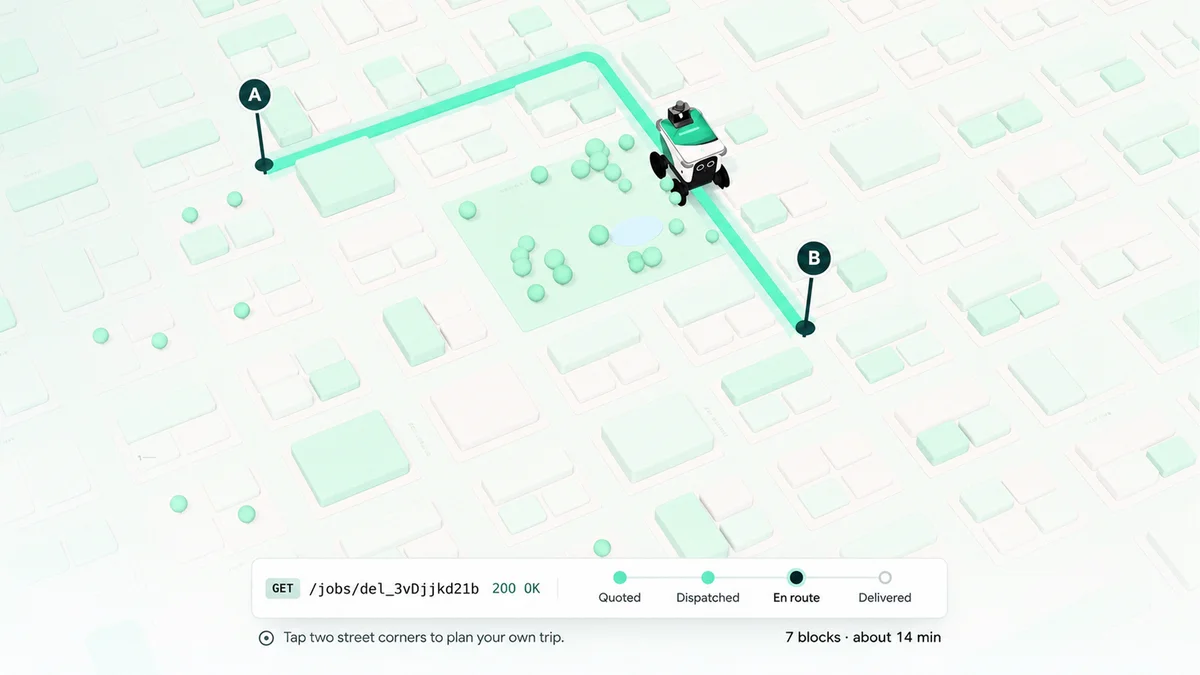
Serve Robotics launched its AV Delivery Developer Portal on Nov. 11: a public API and a simulated-robot sandbox that let developers, businesses and AI assistants quote, dispatch and track its sidewalk delivery robots without going through a delivery app. Serve says it operates 2,000 robots across more than 150 U.S. neighborhoods and has completed deliveries in 20 U.S. cities, company figures.
Live robots are not open to all yet. Serve says access requires its approval, partner signup is "not self-service yet," and jobs are limited to its service areas and hours. CEO Ali Kashani told The Verge that merchants could pay per delivery or reserve robots by the hour at "a fraction" of the cost of human couriers. Serve has published no prices. It follows Serve's August statement that it does not currently expect to renew its Uber Eats deal when it expires in early 2027, unless the operating model improves.
Servospace take: the idle-robot math
Servospace analysis, using Serve's reported Q3 figures: Serve averaged 917 daily active robots, a count that includes hospital robots and, per its 10-Q, robots generating branding revenue. Serve's 10-Q applies the same indoor-plus-outdoor mix to the 11,214 daily supply hours. That 917 is about 46% of a 2,000-robot deployed base; the Nov. 11 release also says more than 2,000 deployed across the U.S. and Australia and does not break the count into sidewalk vs hospital, so 46% is a blended share, not sidewalk-only utilization. Those robots were available for 11,214 hours a day, about 12.2 hours each. Over Q3's 92 days that is about 1.03 million robot hours, against $2.835 million of total revenue, including advertising, software and hospital work: roughly $2.75 per available robot hour at company level, not a sidewalk-only rate.
That spare time is what the portal is built to sell. Kashani told The Verge food demand bunches at lunch and dinner, and that API jobs get the same priority as enterprise orders. Serve's 10-Q says Uber Eats volume came in below expectations and that it expects reduced demand there through the rest of 2026; its largest customer, which it does not name, fell to 10% of Q3 revenue from 43% a year earlier. In August, Kashani said almost two-thirds of orders in Serve's areas can't use robots because of restaurant integration barriers, according to a Zacks summary of the call. The Verge puts delivery-app commissions at 15% to 30% of each order, or $15 to $30 per $100 of food. Whether Serve's per-delivery fee undercuts that remains a company claim until prices are public.
More on Uber and robot business and funding.
The source post
Post by Serve Robotics on X.
View the post on X
Sources
- Serve Robotics via GlobeNewswire: Serve Robotics Opens Its Robot Delivery Network for Anyone to Build On (Nov. 11, 2026)
- The Verge: Serve Robotics wants to democratize sidewalk delivery robots (Nov. 11, 2026)
- Serve Robotics Developer Portal: Serve Delivery API getting started
- Serve Robotics on X: AV Delivery Developer Portal launch post (Nov. 11, 2026)
- Serve Robotics via GlobeNewswire: Third Quarter 2026 Results, key metrics table (Nov. 5, 2026)
- SEC EDGAR: Serve Robotics Form 10-Q for the quarter ended Sept. 30, 2026
- Zacks via Yahoo Finance: Serve Q2 Earnings Call Centers on Uber Reset and Lower Outlook (Aug. 10, 2026)
New to robots? Read our guide: How robots work: a beginner's guide.
Summarized by Servospace from the sources above, drafted with AI help and checked against those sources before publishing. Claims are the companies' or outlets' unless we say otherwise. How we work.