Guide
Robot trailer loading vs unloading: what is actually proven?
Customer accounts establish that dock robots load and unload freight. They do not establish a common sustained rate or a labor-free dock. FedEx confirms expanded Dexterity loading, UPS names Pickle Robot for unloading, and DHL describes commercial Stretch unloading. For a buyer, the unresolved question is how much accepted freight the entire dock process handles, with how much human work, over representative shifts.
The more revealing evidence is often outside the product announcement. FedEx's investor-day transcript separates rollout ambition from assumptions in its financial outlook. A historical Boston Dynamics webinar gives an intervention percentage but leaves its denominator unstated. An integrator's Pickle documentation explicitly allows manual palletizing after robotic unloading. These details change what a buyer needs to validate.
Analysis based on public sources checked November 7, 2026, with every material source rechecked November 8, 2026. AI assistance was used in research and drafting. Servospace did not visit these sites, test the robots, interview the speakers or audit operating logs.
In this analysis
- Loading and unloading solve different problems
- FedEx's rollout ambition is not a measured savings result
- Intervention percentages leave out much of the labor
- Freight and conveyor eligibility come before speed
- The public throughput numbers cannot be ranked
- A faster retry rule can leave a dock question open
- An acceptance test and an economic boundary
- What would change this assessment
Loading and unloading solve different problems
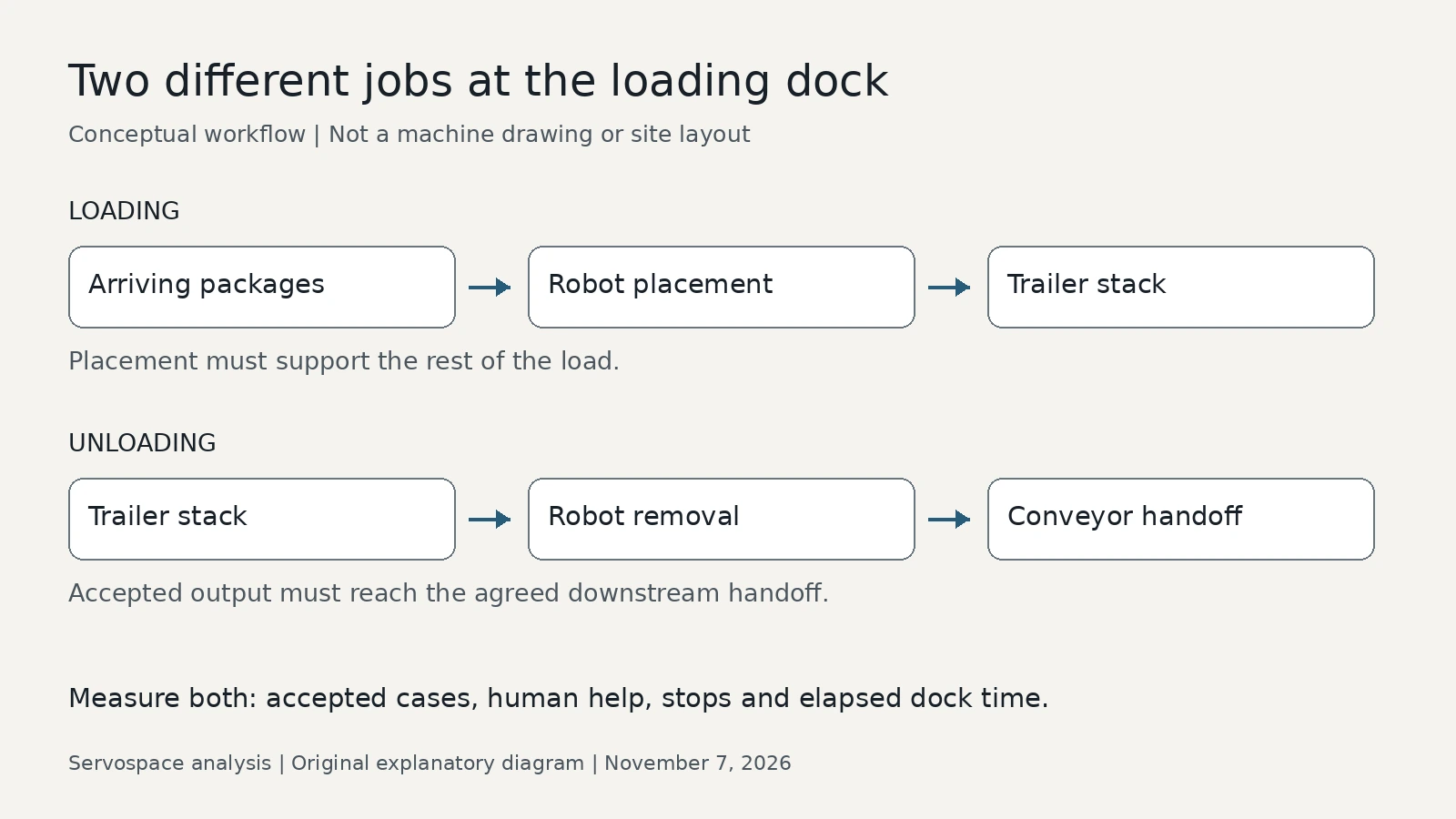
Dexterity's loader must build a load. FedEx describes its dual-armed Mech robot and Foresight model as considering package placement for space, stability and speed, using vision, depth and touch. Stretch removes an existing stack and places cartons on a conveyor. These are the descriptions in FedEx's July 30, 2026 release and DHL's January 31, 2023 account, not independently validated capability benchmarks.
A successful loading movement must contribute to a load that meets the customer's requirements. A successful unloading movement must deliver freight to the next process in an acceptable condition. A pick count alone cannot establish either result.
For the control-loop basics, see how robots work. The robot-video checklist explains why a clean demonstration cannot establish a reliable working shift.
Vendor attribution needs the same care. UPS's September 27, 2023 release names Dexterity, Fortna and Plus One Robotics for small-package pick-and-place, then names Pickle Robot for trailer unloading. That is historical customer confirmation of different jobs. It does not validate Dexterity's FedEx loading performance or establish UPS's current robot inventory.
A larger UPS figure needs a different label. Bloomberg reported on December 15, 2025, citing people familiar with the matter, that UPS would invest $120 million in 400 Pickle unloading robots. Asked about the report, a UPS spokesperson told CFO Dive that UPS has a working relationship with Pickle but has "not announced specific purchases or planned deployments of Pickle's solutions," adding that its technology agreements "are often contingent upon successful testing before we make additional purchases." Pickle declined to comment on the report while confirming that UPS has been a customer for a few years, TechCrunch reported. In the sources reviewed through November 8, 2026, the 400-robot order remains a reported purchase, not a customer-confirmed deployment. Dividing the reported total by the reported count would not produce a verified unit price.
FedEx's rollout ambition is not a measured savings result
The strongest customer-side chronology contains three different kinds of evidence.
| Customer document | What FedEx says | What it does not establish |
|---|---|---|
| Investor day, February 12, 2026, transcript page 20 | Kawal Preet says FedEx plans to deploy physical AI, starting with trailer unloading and loading, across thousands of dock doors in more than 20 US hubs over the next few years. | This is a forward-looking network plan. It is not a count of installed robots, a Dexterity-only award or a completed rollout. |
| Hagerstown announcement, July 30, 2026 | FedEx describes expanded Dexterity autonomous trailer loading beyond its earlier pilot site. | The announcement does not supply comparable sustained throughput, intervention logs or site-wide automation coverage. |
| Holiday operations update, November 5, 2026 | FedEx says systems from Dexterity and Berkshire Grey are autonomously loading and unloading trailers. | The grouped sentence does not assign both tasks to each supplier, identify sites or disclose robot counts, rates or labor requirements. |
The investor-day question-and-answer session adds a qualification missing from a simple rollout headline. Asked by TD Cowen analyst Jason Seidl how much adoption of the loading and unloading robots, specifically around headcount, was built into the outlook to 2029, CFO John Dietrich said:
"[O]ur outlook is not dependent on or factoring in any material numbers with regard to that kind of automation."
When Seidl asked whether it was potential upside, CEO Raj Subramaniam answered, "It's potential upside." The exchange is on transcript page 46, followed by Preet describing the technology as early innings on page 47.
This does not prove that the robots have no economic value. It shows that, at that February event, a large customer could describe an ambitious rollout while declining to base its outlook on material benefits from that category of automation. Nor does the February answer establish what FedEx assumed in any later forecast. A deployment announcement and a quantified financial contribution are separate evidence questions.
Hagerstown also exposes the integration work around the machine. FedEx lists destination planning, trailer assignment, maintenance and workforce processes. FreightWaves' July 31 report attributes to FedEx spokeswoman Christina Meek that later deployment decisions depend on safety, operating performance, reliability, business needs and lessons from evaluation at larger scale. That is attributed customer comment, not a Servospace interview or independent performance test.
Intervention percentages leave out much of the labor
An unusually specific historical claim still lacks a denominator
In Boston Dynamics' "Impact your inbound" webinar transcript, a speaker says most production sites were running an intervention rate of "0.1% to 0.4% on average."
The page's structured metadata gives an original publication date of April 17, 2023, and a modification date of March 5, 2026. The transcript describes early production units and future expansion. Treat the claim as historical, not as a current Stretch Gen 2 result. A recently modified page is not a recently measured fleet.
The passage supplies neither a clear denominator nor the duration of assistance. It does not define whether an intervention is counted per case, attempt, container or another event. It cannot be converted into uptime, stops per hour or paid labor hours without those definitions. The fleet sample and observation window are also unstated.
The same discussion calls one associate managing five or six Stretch-equipped doors an area to pursue with customers over the following year. It is a staffing aspiration in that source, not an achieved or current staffing guarantee.
Setup and downstream work are not necessarily interventions
Crown Packaging's Pickle system description identifies work outside the autonomous pick sequence. Staff position the equipment, inspect for hazards and obviously ineligible freight, start the process, respond to exceptions and reposition it after unloading. Most importantly, the connected conveyor can feed either manual palletizing on the dock or an automated downstream process.
Crown is a commercial seller, not an independent labor auditor. Its description nevertheless makes a boundary explicit: an automated trailer can still deliver cartons to people doing the next job. Counting only robot interventions would omit that work.
Pickle's own technology description says operators can correct which box to pick, hand placement and carton orientation on the conveyor. That documents an assistance mechanism. It does not disclose how frequently operators use it or how much staffing it requires.
The same documents also make favorable labor claims. Crown says these staff interactions "take just minutes per container," and Pickle's product page says its robots "cut unload labor by up to 80%." Neither publishes the labor boundary, freight mix or measurement window behind the figure. Treat both as vendor claims to test, not measured staffing results.
The useful staffing question is therefore broader than "How often does it stop?" It is how many human minutes the complete workflow requires, including normal setup, supervision, exception response, changeover and the agreed downstream handoff. Record remote support as well as onsite labor. Do not treat several robots assigned to one console as proof that one person can service their simultaneous demands.
Customer exceptions provide a concrete counterweight
In a June 19, 2025 interview with Automated Warehouse, DHL's Tim Tetzlaff describes sending Boston Dynamics wet or dented boxes and cartons with failing tape because ideal lab cartons did not represent real freight. He says an open-top carton or missing tape can require an associate to intervene, while a fallen box can be recovered automatically.
Those examples distinguish a recoverable arrangement problem from packaging the system cannot handle unaided. They are dated customer testimony, not measured exception frequencies or proof that every later model has the same limitation.
There is counterevidence to dismissing the system too. Tetzlaff argues that a human may be faster initially but cannot sustain that pace. DHL's 2023 commercial announcement says Stretch exceeded manual unloading speeds in all environments tested. Neither account publishes the matched human baseline, full labor boundary and operating dataset needed to make that comparison portable to another warehouse. Retain the favorable customer claim without turning it into an independently reproduced benchmark.
Freight and conveyor eligibility come before speed
The relevant buying unit is a qualified freight-and-dock configuration, not an unrestricted claim to unload containers.
| Public document | Published boundary | What a buyer must resolve |
|---|---|---|
| Boston Dynamics Stretch brochure, retrieved November 7, 2026, specification page (page 7) | Rectangular cardboard boxes with taped or glued flaps. Maximum case weight 50 lb. Minimum length of any surface 6 inches and maximum 36 inches. Telescopic conveyors of various brands. Operating environment 5 to 45 degrees Celsius. | Confirm the exact model, carton eligibility, site environment and conveyor configuration. The file sits in a March 2026 directory, which is not proof of its publication date or applicability to November's Gen 2. |
| Pickle's unloading product page, retrieved November 7, 2026 | Floor-loaded freight, cartons up to 50 lb and sizes from 6-inch cubes to 24 by 24 by 32 inches. | Obtain a configuration-specific acceptance envelope. Do not infer compatibility with every package or trailer. |
| Crown Packaging's Pickle listing, retrieved November 7, 2026 | Up to 60 lb and 24 by 24 by 30 inches, with a telescoping extension or powered flexible conveyor. | These limits conflict with the manufacturer's page. The listing is undated. Do not combine the larger weight from one page with the larger dimension from another. |
The public material does not resolve whether the Pickle discrepancy reflects age, model or configuration. It is not evidence that either system can safely handle the union of both specifications. A current, configuration-specific specification and representative-freight acceptance test would resolve the procurement question.
The Stretch brochure also describes automatic backout after unloading, followed by an operator driving the robot to another dock. That matters when counting changeover labor. A feature can remove one manual step without making the entire work cycle autonomous.
Pickle advertises "no WMS integration", referring to the warehouse management system. That does not mean no physical or process integration. Crown describes conveyor connections and downstream handoffs. FedEx separately describes planning and workforce integration for loading. These are different kinds of integration, not contradictory claims about the same task.
Past the dock, the same gap between contracted, accepted and measured systems shows up in storage and order-building automation. Our Symbotic and Walmart analysis applies those labels to Walmart's case-handling contracts.
The public throughput numbers cannot be ranked
DHL's 700 and 500 remain unreconciled
| Source and date | Published figure | Measurement boundary |
|---|---|---|
| Boston Dynamics historical webinar, originally published April 17, 2023 | Speaker describes 400 to 600 cases per hour as the average across production deployments, depending on freight. | Historical manufacturer statement. No raw distribution, shift boundary or comparable labor dataset. |
| DHL release, May 13, 2025, repeated in July 9, 2025 release | Deployments achieved "up to 700 cases per hour." | Customer-reported upper-bound figure. No matched trailer mix, sustained window or intervention accounting. Repetition is not a second independent test. |
| DHL's 2025 reporting microsite | "Performance: Up to 500 cases per hour." | Report year is known. Publication date, model, site and measurement window are not specified in the passage. |
| Boston Dynamics brochure, retrieved November 7, 2026 | 600 to 800 cases per hour. | Manufacturer specification, not a matched DHL measurement. |
| Stretch Gen 2 announcement, November 3, 2026 | "Up to 1000 cases per hour," highly dependent on case weight and stack order, with multipick supporting peak rates. | A newer generation and a manufacturer claim. Not a published DHL sustained Gen 2 result. |
The original dated DHL releases confirm 700. The reporting microsite confirms 500. Neither explains the other. They might concern different conditions, but the reviewed evidence does not establish that explanation. It also does not establish a regression from 700 to 500, a conservative-versus-peak split or a doubling from 500 to 1,000.
Searching the text extracted from the annual-report PDF linked by the microsite returned no occurrence of "Stretch," "Boston Dynamics" or "cases per hour." That is a bounded text-search result, not proof about unsearchable graphics. The 500 claim is supported by the web presentation. This analysis does not call it an audited operating result merely because it appears on a reporting site.
DHL had already qualified unloading speed by product in 2023. That condition belongs beside the rates. It does not supply the missing reconciliation.
Faster picking is not the same as more accepted freight per shift
Boston Dynamics says the Gen 2 redesign targets causes of unplanned downtime identified in earlier deployments, including connector, wiring and serviceability issues. This is useful evidence about design priorities, not measured customer availability after the redesign. Our Stretch Gen 2 news story covers the announcement itself.
Peak speed, active-time average and full-shift accepted output answer different questions. A higher peak does not settle how often the equipment waits, needs assistance or feeds a downstream process that cannot accept its output.
A faster retry rule can leave a dock question open
An April 28, 2026 diginomica interview with Pickle CTO Ariana Eisenstein describes a more instructive improvement than a headline maximum rate. Analysis of a customer's entire fleet suggested a third grasp retry had a very low success rate and added an average of four extra seconds per cycle. The article puts the robot's average cycle time at around six seconds. Pickle changed a configuration value, and Eisenstein said the change produced an immediate "bump in this critical metric that effectively sets the tempo for the rest of the building."
The public account does not provide the raw event data, customer identity, affected share of cycles or a before-and-after accepted-output table. The outlet also discloses that Celonis was a partner. This is an on-record vendor explanation through a third-party publication, not independent verification of a measured gain.
There is a primary-source cross-check on the surrounding project. Celonis' February 18, 2026 release confirms work with LeafLabs and Pickle. Its "50% acceleration" refers to core processing development, not a 50% increase in customer unloading throughput. It does not independently verify the later retry example.
The original implication is a question to test, not a result to invent. When the robot spends less time retrying, what happens to that carton next? If a person resolves it, exception labor may rise even while a cycle metric improves. If another automated strategy resolves it, useful output may improve without that tradeoff. The reviewed sources do not disclose which outcome followed the configuration change. Buyers need the disposition of failed picks alongside successful cycle times.
An acceptance test and an economic boundary
The following is Servospace's proposed evaluation framework, not a published test result, engineering safety standard or forecast.
Define unloading completion as an accepted case delivered to the agreed downstream handoff. Define loading completion as an accepted case placed in a load meeting the customer's specified requirements. Record both active handling rate and elapsed dock rate. Divide accepted cases by active handling hours for the first. Divide the same accepted count by the full agreed operating-window hours for the second.
Keep raw counts and time logs. Define the window before testing, including setup, waiting, assistance, changeover and maintenance as applicable. Record how much freight was ineligible and handled by another route. A high rate on a selected subset cannot answer how an entire arrival schedule gets processed.
| Decision | Evidence that would change it |
|---|---|
| Can this system handle our freight? | Exact model and carton envelope, representative trailer and packaging mix, eligible share, rejects and damage. |
| Can our dock meet its schedule? | Accepted output across representative shifts, with peak, active and elapsed rates labeled separately. Include conveyor waiting and downstream capacity. |
| How many people are needed? | Normal handling and setup minutes, exception counts and durations, concurrent calls, onsite and remote support, and labor through the agreed handoff. |
| Will capacity persist? | Availability and maintenance logs, service response, software version and recovery reasons. Do not substitute intervention frequency for availability. |
| Is this economically preferable? | Matched accepted volume and the full incremental cost boundary, including equipment or service fees, integration, support and rework. |
Payback claims need their operating assumptions
The historical Boston Dynamics webinar associates about two-year payback with early customers running two robots across two shifts a day, in those customers' own return-on-investment (ROI) calculations. Pickle's product page says most deployments pay back in 18 months. Neither supplies a comparable public cost ledger. The figures do not identify a cheaper vendor.
DHL's January 26, 2022 announcement discloses a $15 million, multi-year Boston Dynamics robotics agreement, beginning with Stretch. It gives no unit count or allocation sufficient to calculate a robot price. Dividing that total by the separate 2025 memorandum's proposed 1,000-plus future deployments would combine different agreements and years into a fabricated unit price.
A symbolic calculation is more honest than inventing the missing inputs. Let F be incremental upfront equipment and integration cost. Let H be annual paid labor hours genuinely avoided at matched accepted output, after all remaining robot-workflow labor. Let w be the fully loaded hourly labor cost, and C the additional annual nonlabor operating cost, net of the manual baseline.
Annual cash saving = w × H − C
Simple payback in years = F ÷ (w × H − C), only when the denominator is positive.
For a service model, place recurring service fees in C rather than inventing an acquisition price. Capacity released for redeployment is not automatically payroll avoided. Model it separately. Test sensitivity to eligible freight share, actual avoided hours, shifts available, exception time and support cost. This simple relationship omits financing, taxes, discounting and changing volumes. No numerical return is estimated here.
What would change this assessment
The evidence supports a narrower and more useful conclusion than either "just a demo" or "the dock is autonomous." Customers describe real uses. They also describe continued evaluation, assistance and integration. The more detailed manufacturer material exposes conditions that a product video leaves out.
The strongest favorable evidence is customer confirmation, including DHL's commercial deployment and manual-speed comparison. The strongest limitation is the absence of a matched operating dataset in the sources reviewed here, not proof that the machines fail or cannot pay back. FedEx's February financial caveat must be read at its date, just as a 2023 staffing aspiration must not become a 2026 staffing fact.
A dated customer dataset covering representative shifts would materially strengthen this assessment. It needs accepted and rejected freight, total elapsed time, eligible freight share, interventions with duration, normal staffing and downstream work. A documented reconciliation of DHL's two rates would resolve that specific discrepancy. A subsequent deployment announcement alone would not fill those gaps.
How the sources were used
This is public-source analysis. Customer publications establish what customers said about plans or use. Manufacturer and integrator documents establish their published claims and workflow descriptions. A customer executive's interview and a vendor executive's interview retain their attribution. A joint or syndicated release remains one underlying source, however many sites repeat it. No source reviewed here constitutes an independent Servospace performance audit.
Publication dates identify documents, not installation acceptance dates. Announced, ordered, pilot, operating, commercial and paid status answer separate questions. None is inferred from another. This analysis does not infer current fleet totals, revenue, injury reduction or eliminated jobs.
A Dexterity patent application was also checked for upstream feed-control disclosures. A patent discloses a design. It does not establish which features were implemented at FedEx, so no deployed capability is inferred from it. Some customer and investor-document leads could not be retrieved. The research log records those access limits. This review is not a claim that every public source has been found.
Review this guide when a customer publishes sustained operating results, a relevant model or workflow changes, or conflicting source figures are reconciled. Otherwise, recheck within 90 days. Corrections can be sent through Servospace's contact page.